Showing posts with label Space And environment. Show all posts
Sunday, 6 December 2015
Saturday, 5 December 2015
Wednesday, 2 December 2015
Monday, 30 November 2015
What If? Metropolis - Texture Swatches
Today we were taught how to make texture swatches in Photoshop. I took a marble texture from google images and used the offset tool to adjust the image settings, and then I cropped the image and duplicated it several times until the texture covered the whole canvas. Then, I used the clone stamp tool and spot healing brush to smooth some areas. This is the final texture swatch:
Then, I painted over the texture with pale cream colours and greys/ browns as my city will have a neutral colour scheme. This was just a practice exercise, later, I shall go back and create my own hand-painted textures using reference images. I just wanted to get a good understanding of how to create texture swatches using the techniques we learned today.
Wednesday, 25 November 2015
Monday, 23 November 2015
What If? Metropolis - Chosen buildings
After receiving some feedback from my tutor and from friends, I have decided to pick these three key buildings to use in my final project. Tomorrow, I shall work on drawing my orthographic drawings and painting my production art. The rest of the buildings and structures will be included in the matte painting.
I have chosen some colours based on my artist's work and also from my travelogue.
![]() |
| My central building. I have changed it from an octagonal building, as outlined in my travelogue, to a hexagonal building instead as the form looks much better as a hexagon. |
Saturday, 21 November 2015
@Phil WIM - Rationalised thumbnails
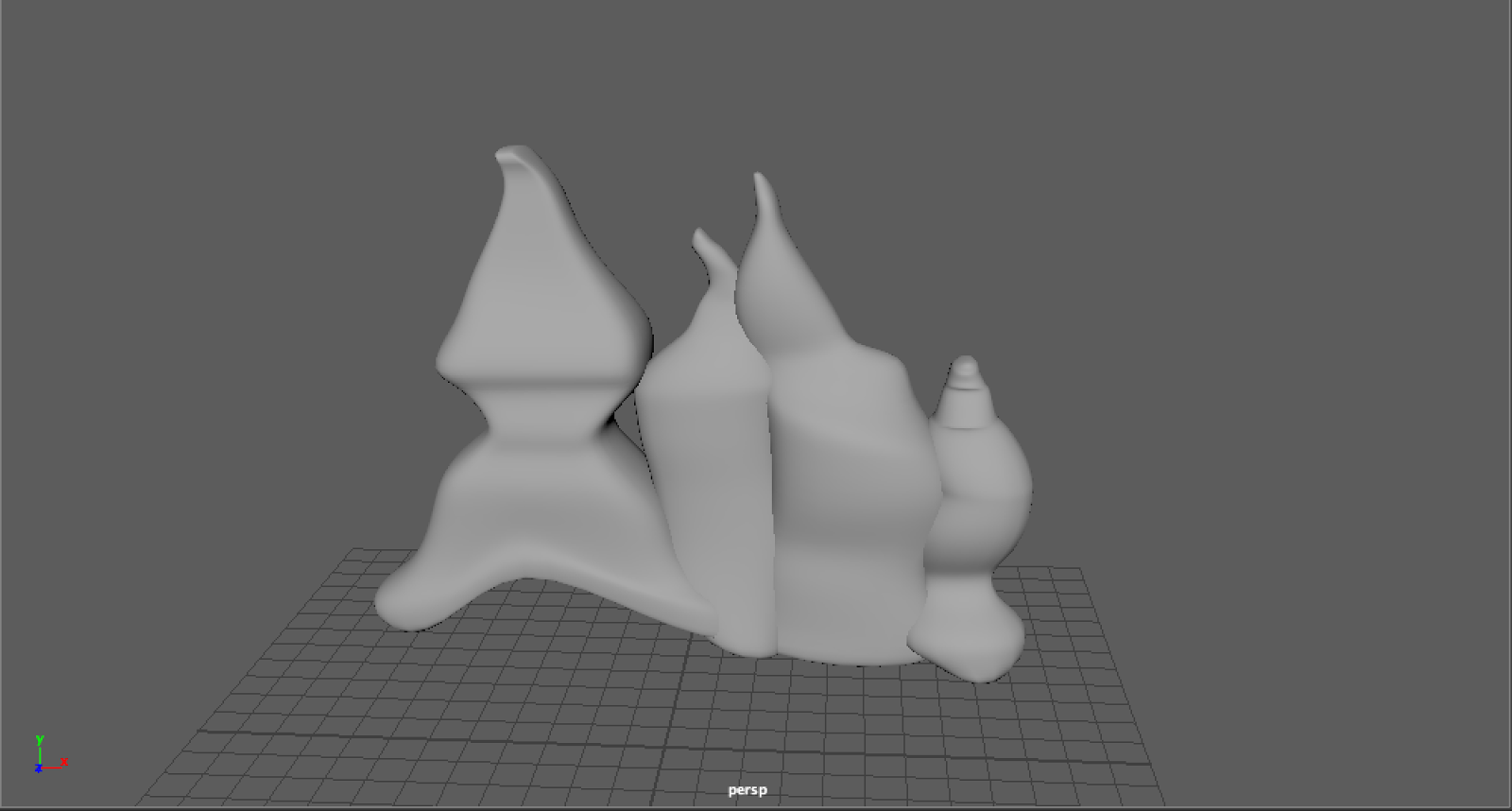
I tried to make new thumbnails by rationalising the shapes a little more and trying to prevent them from looking like sculptures.
Could these work better as building structures? Personally, I like 93, 96, 97 and 99. What do you think? Also, I was thinking of keeping some of my geometric thumbnails like A and B (at the bottom) B is supposed to be what plant life look like in my city. Also, I still like the idea of my central building looking like A. Bourgeois' work is a mixture of geometric and soft, round sculptures so I think a mixture of the two different forms in my world could work, but I do require your advice on all of this.
Monday, 16 November 2015
La Belle et la Bête (1946) Film review
![]() |
| Fig. 1 La Belle et la Bête (1946) official movie poster |
La Belle et la Bête (1946) directed by Jean Cocteau, is a classic live-action rendition of the Beauty and the Beast fairytale. 'Cocteau re-creates the classic story of the beauty who gives herself to the beast to save her father, and whose growing love eventually transforms him into a handsome prince.' (Druker, 2012) The film discusses various issues such as love and greed, and how beauty can extend beyond appearances. Cocteau's La Belle et la Bête inspired Disney's 1991 Beauty and the Beast animation and in 2013, Ethery Pagava created a ballet influenced by Cocteau's film.
The film was made 'in the immediate aftermath of World War II, and offered French cinema audiences what they most craved: pure escapism, blessed relief from the painful memories of the occupation and the penury of the post-war austerity.' (Travers, 2000) The film was directed by the famous French poet and playwrights, Jean Cocteau and many critics have described the film as 'a fanciful poem in movement' (Crowther, 2003) The director, Jean Cocteau was described by people as 'The Poetic Prince of French Cinema.' (Spradley, 2015) This was because he was skilled in many different art forms, including painting, poetry, drawing, filmmaking and acting. In 1946, he directed his first narrative film La Belle et la Bête which was based on the famous children's story Beauty and the Beast by Madame Leprince de Beaumont. This film became a huge hit amongst French cinema audiences and was among Cocteau's most famous films. 'With this film, Cocteau reached a new level of artistic fusion, combining mythical narrative, visual poetry, cinematic trickery and even his own child-like writing in the credit sequence.' (Spradley, 2015)
'Despite the many challenges that confronted them, Cocteau and his dedicated team succeeded in crafting one of the great cinematic jewels of the 20th century.' (Travers, 2000) Cocteau's film crew experienced many difficulties while filming La Belle et la Bête, electricity was unreliable and film was scarce therefore Cocteau's production crew often worked by candlelight. Cocteau's poor health was also a major obstacle during the production of the film. 'The director had a serious skin condition which made him allergic to the strong studio lights, and he narrowly survived a life-threatening attack of blood poisoning.' (Travers, 2000) Regardless of the difficulties faced by the director and his film crew, they succeeded in creating a film with marvellous visual and technical brilliance. Critic, Brealy states: 'it is a brilliant fairy-tale fantasy, well ahead of its time.' (Brealy, 2012)
Today, 'La Belle et la Bête is still one of the best French films ever made.' (Langdon, 2003)
Bibliography
Text sources:
Druker, D. (2015) Beauty and The Beast. At: http://chicagoreader.com/chicago/beauty-and-the-beast/Film?oid=1050821 (Accessed on 16.11.15)
Langdon, M. (2003) Beauty and the Beast. At: http://www.amc.com/movie/1956/Beauty+and+the+Beast (Accessed on 16.11.15)
Spradley, P. (2015) Jean Cocteau: The Poetic Prince of French Cinema. At: http://www.theculturetrip.com/europe/france/articles/jean-cocteau-the-poetic-prince-of-french-cinema/ (Accessed on 16.11.15)
Travers, J. (2000) La belle et la bete (1946) - Jean Cocteau - film review. At: http://www.filmsdefrance.com/review/la-belle-et-la-bete-1946.html (Accessed on 16.11.15)
Illustration list
Fig. 1 (1946) [Poster] La Belle et la Bête official movie poster. At: http://theredlist.com/wiki-2-24-224-267-view-fiction-profile-beauty-and-the-beast.html (Accessed on 16.11.15)
Tuesday, 10 November 2015
Edward Scissorhands (1990) Film review
![]() |
| Fig. 1 Edward Scissorhands (1990) official movie poster |
Edward Scissorhands (1990) is a fantasy romance film that is set in the suburbs of 1950-70's America. The film discusses what it means to be an outsider, but most importantly it criticises humanity, portraying them as cruel and prejudiced as they struggle to overcome their fear of the unknown. Edward Scissorhands was directed by Tim Burton and was one of his most personal films as 'it reflects his own childhood and isolation.' (Animation Begins, 2012)
It is very likely that Burton was influenced by German Expressionism when making his set design and characters. German Expressionism was a movement that began in the 1920's, during the reign of the Weimar Republic. 'Clearly the movement was meant to be opposite from realism, with set designs that were often very unrealistic and themes that dealt with insanity, betrayal, and other topics that were unlike the adventure and romantic movies of the time.' (Cott2, 2013) The inventor's castle in which Edward resides in has a strong German Expressionist appearance, 'the windows, beams, and pillars are all crooked or broken which not only shows the 'distorted shapes and set' theme that German Expressionist films often had, but this set is also accompanied by chiaroscuro lighting, often used in German Expressionist films' (Cott2, 2013) like Des Cabinet des Dr. Caligari (1920). Burton was actually influenced by this film when creating Edward Scissorhands as it was one of the first German Expressionist films ever made. Both films use dark, distorted buildings and Gothic set design. 'Also, both Edward and Cesare share a similar physical appearance; tall with very dark features and a pale complexion.' (Cott2, 2013) However, in an interview by Burton's ex-partner Helena Bonham Carter, she states that 'Edward is actually another version of Burton himself, as they both have a pale complexion and dark, sunken eyes.' (Animation Begins, 2012)
1950-70's America was a era of great change, particularly due to the development of the suburbs in 1950 which led to great prosperity and better opportunities being available to families. Most white, middle-class Americans migrated to the suburbs in hopes for a better, more quieter life away from the city. This mass migration later became known as the the 'white-flight'. 'The white families that moved into the suburbs were the perfect picture of conformity - living in row upon row of identical 'Levittown' houses, with little individuality and distinction.' (Aboukhadijeh, 2014)
![]() |
| Fig. 2 A still from Edward Scissorhands showing American suburban houses |
This is clearly evident in Edward Scissorhands, Fig 2. Here we see pastel coloured suburban houses, built together, emphasising the close knit community in the neighbourhood. 1950's-70's America was also a time of great American consumerism with the introduction of the television which became a very successful advertising platform to promote the various goods produced by the 'mass market'. 'By the end of 1950, ninety percent of Americans owned a television, and nearly all owned a radio. Television and radio acted as tools for marketers to dictate the values of American society in order to help sell their products.' (Aboukhadijeh, 2014) In addition, television programs such as The Donna Reed Show' and Father Knows Best frequently portrayed the traditional, idealised, suburban family which usually took the form of two parents and two children. The Boggs family are exactly this, when Peg Boggs (Dianne Wiest) first invites Edward (Johnny Depp) to her home, she shows him a picture of her family, which consists of her husband (Alan Arkin), her son Kevin (Robert Oliveri) and her daughter, Kim (Winona Ryder). This suggests that American families strongly followed this ideal family life that was expected from society.
The term 'teenager' was first introduced in 1950 following the arrival of popular music icons such as Elvis Presley and actor James Dean. This term was frequently associated with juvenile delinquency. Young people were unwilling to adhere to the acceptable lifestyle choices of their parents which usually meant having a steady job, a home, and a family. 'America's youth rebelled and attempted to escape from a traditionalist society.' (SarahJay, 2008) This notion is shown through the characters of Kim and her boyfriend, Jim who are first seen at night, coming out from the back of a van belonging to Jim's friend, and later on Jim is shown drinking bottles of alcohol and complaining about his father, who has refused to loan Jim a large sum of money. This leads to Jim's cruel plan of getting Edward to break into his home and stealing the money for him, which leads to Edward's arrest and humiliation.
Bibliography:
Text sources
(2013) German Expressionism’s Influence on Tim Burton's Edward Scissorhands. At: https://storify.com/cott2/german-expressionism-s-influence-on-tim-burton-s-e (Accessed on 10.11.15)
Aboukhadijeh, F. (2014) The ‘50s and ‘60s: Decades of prosperity and protest (DBQ) - AP U.S. History sample essays - study notes. At: https://www.apstudynotes.org/us-history/sample-essays/the-50s-and-60s-decades-of-prosperity/ (Accessed on 10.11.15)
Animation Begins (2012) The Influences and the Gothic style of Tim Burton. At: https://animationbegins.wordpress.com/2012/01/29/the-influences-and-the-gothic-style-of-tim-burton/ (Accessed on 10.11.15)
Film4 (2008) 'Edward Scissorhands - A Film Review' At: http://www.rottentomatoes.com/m/edward_scissorhands/ (Accessed on 10.11.15)
Jay, S. (2008) 'Tim Burton and 1950s America' At: https://sarahjay.wordpress.com/ (Accessed on 10.11.15)
Larsen, J. (2008) Edward Scissorhands. At: http://www.rottentomatoes.com/m/edward_scissorhands/ (Accessed on 10.11.15)
Illustration list
Fig. 1 (1990) [Poster] Edward Scissorhands official movie poster. At: http://www.impawards.com/1990/edward_scissorhands_ver1.html (Accessed on 10.11.15)
Fig. 2 (2013) A still from Edward Scissorhands showing American suburban houses. At: https://www.pinterest.com/tesskornfeld/edward-scissorhands/ (Accessed on 10.11.15)
Monday, 9 November 2015
What If? Metropolis - Collaging Thumbnails
Today in Jordan's class I experimented with some collaging, taking various sculptures of Louise Bourgeois and collaging them to make something new. The results are quite interesting and I particularly like the look of 79, 81 and 82 - I can imagine these as key buildings and structures in my city.
Sunday, 8 November 2015
Saturday, 7 November 2015
What If? Metropolis - Cerveau Travelogue
Cerveau travelogue
Eery, strange and whimsical. The city of Cerveau lures you in, mesmerising you with its surreal atmosphere the moment you set foot onto its cold, marble slabs. You blink a few times to clear your vision but no matter how many times you blink, the strange vision will not disappear. You have no memory of how you travelled here. You slowly but cautiously make your way down the marble path, empty space all around you, you focus straight-ahead, at the figure of an oval structure further down the path. As you approach it, you realise the oval structure is the exact replica of a human brain, but magnified at a huge scale. As you inspect it closer, you notice that the wrinkled surface gives it the appearance of a walnut, except it has a sickly-pale pinkish colour and it is glistening with moisture. You circle around it, looking for something - perhaps a door? As you do this, you cannot help but hear chattering coming from inside of the brain. You bring your ear closer to it and as you do, low, flat tones reach your ears. You find this baffling, although you become more and more intrigued.
The atmosphere is making you feel dizzy, you are extremely perplexed. Suddenly, you find a small door floating to your right. It is made of wood, and extremely old and gnarled and you realise that moss is growing on some parts of it, leaving bright green marks on the wood. You look for a doorknob, there is none so you gently push against the door and it gives way. You climb in but it is dark and you cannot see much except for a faint light shining all the way at the bottom. Before you can think about this, you are pushed down a long, giant slide. As you slide down you see glimpses of ghostly figures, but they disappear in the blink of an eye.
As you reach the bottom of the slide, you see a great big building in the shape of an octagon with two triangular shapes jutting out from the bottom of it, resembling legs and two thin, spindly arms pointing upwards in a ninety degree angle. Upon closer inspection, you notice the shape has spider web like pattern and a giant blinking eye in the centre of it. You begin to circle the octagonal building and examine the structure more closely. The structure itself appears perfectly shaped however, on closer inspection, you notice the contour of the building to be imperfect. As you continue moving about the outside of the structure, you notice the eye in the centre of the building moving each way you move as if watching and observing you. You shout at it for a reply, but it does not answer nor change in a way you could understand to be a reaction. As you focus away from the building, you see behind the structure, in the sky, many eyes.
The sky itself, you find, has a deep blue colour but is overlaid with differing colours that randomly shift in hue. Stretching across the sky you see a faint, flat web like structure, the only features that stand out are the large eyes. Each eye being slightly different in shape and colour, but still has the same endless glare as the central building. As you observe them to see if they follow you, you find that they do not move at all, as if your too far away to see or perhaps they serve a different function other then watching their surroundings. Passing in front of the eyes you see ghost-like beings flying across the sky. From this distance you cannot see them clearly only hear a quiet chattering emanating from the figures. You make out however, that they are flying with their hands forward, they have no legs only tails that spiral from their central body. You move away from the central structure, still with its looming eye staring at you and make your way to the smaller structures surrounding the central building.
As you walk upon one of the smaller buildings you notice at first glance that it seems to be made out of some web-like material, forming into what looks like a beehive with a bluish hint. Large tendons of webbing spread out from the structure near the ground which seem to keep it standing as the building itself juts out and enlarges in certain sections. The tendons themselves seem to connect to other structures that stand across the city not just at the base but in the sky as well; large tendons of webbing connecting all the structures except the central building. As you look up at the building in front of you, you notice just like in the previous building an ever watching eye exists in the central section of the building, always keeping a steady gaze as you walk closer to the structure. In front of the building there lays a staircase of the same material leading to some sort of entrance. As you get closer you begin to hear chattering. Too subtle to be actual talking but it strikes you as if there could be someone to talk to. After reaching the top of the stairs you peer into the small opening finding the source of the chattering, seeing ethereal-like human forms floating about the inside. They seem to not notice you nor each other as they seemingly wander inside the building. The building's interior appears to be a maze, with many doors and many paths leading to seemingly impossible lengths as they outstretch the outside geometry of the building. The architecture you notice, has a certain flow to it that seems aesthetically pleasing to look at. The ghost-like figures seem to pass down the halls and up the narrow stairs to different rooms. You look at their faces, which to your shock have no mouths and have only one eye however are still able to make noises as you continue to hear the quiet chatter among them. Each however you notice experiencing different emotion and different states of being as you notice some chatter to be more aggressive then others and some to be quiet and calmer. The chattering seems to be not directed at each other but to themselves, as to what they are mumbling, you cannot ascertain. Inside the rooms you notice there being familiar objects that remind you of a home. Shelving, books, a bed all appear to be laid about in random patterns. Peering into the room, you notice it has a strange orange hue to it making you feel calm and at ease. The ghostly figures who inhabit these rooms also appear to be at ease and are more quiet then the ones wandering the halls.
You take your eyes away from the beehive-like building, to observe what looks like trees of a kind of nature. The trees themselves, however, do not have naturalist designs - the shapes are geometric. They have rectangles, triangles and differing polygons straying about a cylindrical shape which can only be described as the trunk. The colour of the polygons that form the bush are green with hints of orange and the trunk is a familiar brown. The ground at which the tree like structure stands you find what looks like dirt in colour and smell, but looking more closely you find the dirt to be made of paper mache. Looking closely, you find the tree’s material cannot be deceived, you find the closer you look the more it seemingly becomes blurry as if fading out of existence. The more you stare at the tree in trying to understand it, the more nauseous you feel, so you turn away from the tree to explore more of the city.
There is another building that stands out across from the central building that you had not noticed before. It stands the same height as the the central building, however, it is made of the same beehive-like material as the smaller buildings. Stepping over the webbing laid about its base, you come to notice there being an obviously large egg-like structure forming the top half of the building. However, there appears to be no eye staring down at you as before. The webbing is unique in that it spirals around to form the egg structure seamlessly looking wrapped. Similar to the previous beehive-like building, there seems to be a staircase leading to an opening inside the building. Coming to the entrance, you see more ghostly figures and an even larger interior structure. The building interior differs however, as the design is more straightforward and less elegant in design as the homely buildings. The ghostly figures in this building move very quickly, and their muttering is much faster than in the smaller buildings. You also notice that instead of muttering to themselves the ghostly figures are interacting and chattering in groups. The hue in colours are also very different as they are a greyish blue colour. You notice once again the impossible geometry of the inside being larger then the structure itself, however the endless hallways feels more to you like a hive as they are all very similar and there is little to no difference. You feel anxious walking into this area and sense a need to accomplish a task- but you do not know what. You become agitated as you see ghosts in certain sections become very angry and chattering loudly, almost yelling at each other. Other ghosts appear in turmoil, the hue shifting depending on the emotion each one is feeling.
You want to leave this building and a moment later, to your surprise, you find yourself outside standing on the marble floor, overlooking the brain structure. You walk up to it and settle down on the cold, marble floor, thinking about all you have observed. In light of the differences of this world, you felt something similar in all the places you explored to the life you have lived, and perhaps in all feelings that were felt, you came to consider that perhaps you had not travelled at all.
Wednesday, 4 November 2015
Monday, 2 November 2015
What If? Metropolis - Mind Map
I created a mind-map as I researched more about my artist and her key influences and ideas, as well as the materials she frequently used to create her artwork. I think it is very interesting how well the concept of sewing connects with ideas of repair and healing and I am starting to get some ideas from this that could be quite useful for the development of my city.
1.) I am starting to imagine my city as a place that used to be a safe haven but over time has become a vile and cruel place due to humans behaving in ways they shouldn't be. This has resulted in the collapse and destruction of a once idyllic city. The spider is very central to this, she continues to repair the city and provide humans with a solution - but this repeatedly fails and the thin, fragile woven web is destroyed over and over again.
2.) My second idea is all about the human unconscious and I want to imagine my city as a huge brain. It will be made up of different parts, each representing the memories and experiences of a particular person. The memories, feelings and experiences that we go through during our lifetime have a profound effect on the brain and the unconscious. If we go through traumatic times, we tend to repress our feelings, rather than deal with it. This has bad long-term consequences as the memories can resurface and hurt us, resulting in insanity and mental illness. For this idea to work really well, I need to research into the brain, the unconscious and coping mechanisms. I already have some knowledge about Freud but I will research more into his work and ideas. For this idea, I have borrowed elements from the game Nevermind but I would like to design the city in the style of Bourgeois and her surreal sculptures.
Subscribe to:
Posts (Atom)